 C. Sivaraj
Traditional SEO answers one question: how do I rank on page one?
AI search answers a different question: how do I retrieve, synthesize, and cite content to answer a user’s query accurately?
This distinction matters because it changes everything about how you optimize.
Why AI Chooses Some Content (and Ignores the Rest)
Ranking vs. Citation: The Core Shift
A page ranking position 1 for “how to structure content for AI” may not get cited in an AI Overview about the same topic. Here’s why.
When you rank for a keyword, Google’s algorithm has evaluated hundreds of signals - domain authority, backlinks, relevance, engagement - to decide your page is the most valuable result for that exact query.
When AI systems cite a source, they’re asking a different question. They’re retrieving small passages from across the entire indexed web, synthesizing information from multiple sources, and selecting which passages to include in their generated answer.
The criteria are relevance at the passage level, extractability, trustworthiness of the source, and uniqueness of the information.
A page ranking on position 15 that contains a specific statistic, a clear definition, or an original framework can get cited instead of the position 1 result - if that passage better answers the user’s underlying question.
How AI Retrieval Works: The Pipeline
Google states that AI features are rooted in core Search ranking and quality systems, and that AI Mode and AI Overviews can use techniques such as query fan-out to explore subtopics and related sources.
Here’s the workflow:
- User query → “How do I optimize content for AI citations?”
- Intent detection → the AI system determines this is an informational query asking for methodology
- Query expansion → the system expands to semantic variants: “passage optimization,” “extraction-friendly formatting,” “entity signals”
- Vector search → the AI creates a numerical representation of the query and searches for passages with similar embeddings across indexed documents
- Passage retrieval → the AI pulls candidate passages (typically 100-500 words) from hundreds or thousands of sources, not just the top 10 ranking pages
- Confidence scoring → each passage is scored on relevance, source credibility, information quality, and uniqueness
- Citation selection → the AI chooses 2-5 passages to synthesize into its response, marking each with a citation link
- Answer generation → the AI writes original text synthesizing the retrieved passages, outputting the final answer with citations
This pipeline explains why 97% of AI Overview citations come from pages already ranking in the top 20 organic results - ranking still matters as a baseline qualifier.
But within that top 20, passage quality, extractability, and trust signals determine citation probability far more than ranking position alone.
Passage-Level Retrieval Changes Everything
The most important implication: the system favors pages that clearly answer questions, define concepts, and explain processes in a structured way. Pages that rank between positions 11 and 20 are also referenced in summaries.
This means a single article can contain both highly citable passages (that get cited in AI answers) and non-citable passages (buried in narrative, poorly formatted, lacking clear answers). Your job is to maximize the ratio of citable to non-citable content.
The CITE Framework: Four Layers to AI Citation
The CITE Framework is a systematic method for designing content that AI systems can confidently retrieve, understand, trust, and cite.
It has four layers, each addressing a different part of the AI citation pipeline:
- C - Content Architecture (Retrievability)
- I - Information Gain (Uniqueness & Authority)
- T - Trust Signals (Credibility & Entity Clarity)
- E - Extraction Optimization (Passage-Level Formatting)
Let’s explore each layer.
C: Content Architecture - Make Content Easy to Retrieve
Goal: structure your content so AI systems can easily find, identify, and extract the passages they need.
AI systems don’t read articles the way humans do. They scan for semantic structure, answer-first formatting, standalone sections, and clear entity signals.
1. Semantic hierarchy (H1 → H2 → H3). Organize content around user questions, not brand narratives. Each H2 should be a natural user question. Each H3 should provide a direct answer.
Example:
Bad hierarchy:
H1: The Complete Guide to Optimization H2: Why Optimization Matters H3: Introduction H3: Why It’s Important
Good hierarchy:
H1: How to Optimize Content for AI Citations H2: What is passage-level retrieval? H3: Definition & How It Works H3: Why It Differs From Traditional SEO
2. Answer-first writing. Place the direct answer to each H2 question within the first 40-60 words under that heading, before any elaboration.
Bad (buried answer):
How does RAG work? The process of Retrieval-Augmented Generation has evolved significantly since its introduction by Facebook AI Research. Over the years, various implementations have demonstrated the effectiveness of combining dense retrieval with large language models. Essentially, RAG works by retrieving relevant passages from a knowledge base and then using them to condition the generation of an answer.
Good (answer first):
How does RAG work? RAG retrieves relevant text passages from indexed sources, then uses them to condition an LLM’s response. This two-step process - retrieval + generation - ensures answers are grounded in real sources.
The broader context: RAG was introduced by Facebook AI Research to address hallucination in LLMs. By retrieving real passages before generating text, RAG systems cite sources and reduce fabricated claims.
3. Standalone sections. Every H2/H3 block must be understandable without surrounding context. This is critical because AI systems extract passages without their full article context.
Test: remove any H2 section and give it to someone unfamiliar with the article. Can they understand it fully? If not, add context.
4. Comparison tables. AI systems extract and cite tables more frequently than paragraphs because tables are pre-structured data. Include at least one comparison table per major topic.
Example structure:
| Factor | Traditional SEO | AI Citation Optimization |
|---|---|---|
| Focus | Search ranking position | Passage retrievability & citation probability |
| Optimization Target | Entire page | Individual passage (40-200 words) |
| Citation Metrics | Rank position, CTR | Citation frequency, AI visibility |
5. FAQ engineering. Structured FAQ sections signal to AI systems that you’ve anticipated common questions. Use this format:
Q: Why do lower-ranked pages sometimes get cited? Because citation priority depends on passage quality, not ranking position. An article ranked #15 could have a higher quality passage containing unique statistics or a more precise definition than the article ranked #1.
6. Heading optimization. Make H2s natural user questions. Avoid generic headings.
| ❌ Avoid | ✅ Use |
|---|---|
| “The Basics” | “What is content architecture?” |
| “Overview” | “How does passage retrieval work?” |
| “Background” | “Why does AI citation differ from ranking?” |
I: Information Gain - Teach What Competitors Don’t
Goal: make your content source-worthy by providing information competitors don’t have.
“Comprehensive” is the minimum bar. AI systems cite content that is both comprehensive AND original.
Most competitors cover the same topics. They define passage-level retrieval, explain why it matters, and list best practices. But they rarely include:
- Proprietary frameworks or models
- Original research or data
- Specific case studies with numbers
- Expert opinions or quotes (verified)
- Unique templates or tools
- Benchmarks or performance data
1. Proprietary frameworks. The CITE Framework itself is a proprietary model. It organizes AI citation optimization into four distinct layers that competitors don’t structure.
Other frameworks exist (CLEAR-AI by W3era, GEO techniques by GenOptima), but if your framework is distinctive and clearly explained, it becomes a reason to cite your content.
2. Original research & data. A Princeton University experiment with Generative Engine Optimization revealed that the strategic utilization of citations, statistical data, and structured information increases the citation rate of AI responses by 40%.
This statistic is citation-worthy because it’s specific, sourced, and provides quantitative validation. Competitor articles without primary research cite this same study. But if you run your own test - even with a small sample of your own pages - you create unique data.
3. Experience-based insights. If you’ve optimized 100+ pages for AI citations, you have observed patterns competitors haven’t. Share them:
- “Pages with author bios see 23% higher citation rates than pages without them.”
- “Schema markup improved our citation rate from 12% to 18%.”
- “Tables were cited 3x more frequently than paragraphs.”
4. Templates & tools. Competitors describe best practices. Provide templates readers can copy directly.
5. Annotated examples. Instead of describing a well-optimized passage, show a real one. Mark up why it works:
Well-optimized passage (citation-ready):
“Generative Engine Optimization (GEO) is the practice of optimizing content to be cited by AI language models. Unlike traditional SEO, which ranks pages for keywords, GEO optimizes individual passages for retrievability and citation probability.”
Why this works:
- Placed immediately after H2 (answer-first)
- 43 words (optimal extraction length)
- Defines term (entity clarity)
- Contrasts with related concept (passage independence)
- Uses primary keywords naturally
T: Trust Signals - Build Credibility & Authority
Goal: help AI systems determine that your content is trustworthy.
Trust is the most underestimated factor in AI citations. Brands with active trust profiles were cited in 75.3% of answers, versus 1% for brands with no active profile - a 75x citation gap.
AI systems evaluate trust through multiple signals:
1. Entity clarity & consistency. AI systems use entity recognition to identify who you are and whether your entity is consistent across the web.
- Your brand name must be spelled identically on your website, Google Business Profile, LinkedIn, Twitter, and Wikipedia (if applicable)
- Organizational schema must include: legal name, URL, logo, contact email, physical address
- A Person schema (author) must include: name, bio, verified social profiles, known expertise areas
Audit: search your name on Google. Look at the Knowledge Panel. Are there conflicting entity names, locations, or descriptions? If yes, consolidate them.
2. Author credibility (E-E-A-T). AI models prefer content that has a verified author background and clear facts.
For each author, create and maintain:
- Author bio (50-100 words) detailing expertise and credentials
- Author schema (Person JSON-LD) linking to verified profiles
- Published byline on every article
- Consistent author name across all content
Bad: Written by “Admin” on May 15, 2026
Good: By Sivaraj | Senior SEO Analyst (5+ years AI search optimization experience)
3. Third-party validation. AI systems check whether external sources confirm your credibility.
- Reviews & ratings: active profiles on Trustpilot, G2, or industry-specific review sites
- Press mentions: coverage in reputable publications (TechCrunch, Search Engine Journal, etc.)
- Speaking & authority: conference talks, published research, industry association membership
- Backlinks: links from authoritative sites (Wikipedia, educational institutions, government sites)
4. Content freshness. AI systems prefer recent content over outdated material. AI Mode can use query fan-out to search across related subtopics and data sources.
- Update publish dates when you substantially revise content
- Add “Last Updated” dates prominently
- Refresh statistics and citations to current sources
- Review and update every 6 months for core content
5. Structured authority signals. Organization schema is a core trust signal:
{
  "@context": "https://schema.org",
  "@type": "Organization",
  "name": "SEOwithSiva",
  "url": "https://www.seowithsiva.com",
  "logo": "https://www.seowithsiva.com/images/logo.webp",
  "sameAs": [
    "https://www.linkedin.com/company/xxx",
    "https://www.twitter.com/xxx"
  ],
  "knowsAbout": [
    "SEO",
    "AI search optimization",
    "Generative engine optimization"
  ]
}
Person schema establishes author authority:
{
  "@context": "https://schema.org",
  "@type": "Person",
  "name": "Author Name",
  "url": "https://www.example.com/authors/xxx",
  "sameAs": [
    "https://www.linkedin.com/in/xxx",
    "https://www.twitter.com/xxx"
  ],
  "jobTitle": "Senior SEO Analyst",
  "affiliation": {
    "@type": "Organization",
    "name": "SEOwithSiva"
  }
}
E: Extraction Optimization - Format for AI Passage Retrieval
Goal: format individual passages so AI systems can extract and cite them confidently.
This is where most content fails. Good content can be poorly formatted, making it invisible to AI extraction systems.
1. Question-first sections. Begin every answer-focused section with a clear question, then a direct answer.
What is entity salience? Entity salience is a ranking of which entities (people, organizations, concepts) are most important in a given context. AI systems use entity salience to weight which passages to cite when multiple sources cover the same topic.
Why it matters: if an article mentions “Google” 50 times and “Microsoft” twice, the AI system learns that Google is the salient entity. It weights content about Google’s products more heavily than content about Microsoft.
2. Standalone paragraphs. Format each paragraph to stand alone. Don’t rely on previous paragraphs for context.
Bad (context-dependent):
There are several ways to optimize. The first is content structure. The second is schema markup.
Good (standalone):
Content Architecture - the semantic structure of your content - directly impacts AI extractability. Use clear H2/H3 hierarchies, answer-first formatting, and semantic HTML.
Schema Markup - JSON-LD structured data - helps AI systems verify entity identity and topic expertise. Implement Organization schema (homepage), Person schema (author bios), and FAQPage schema (Q&A content).
Citation Freshness - the recency of your content and claims - influences whether AI systems cite you. Update core articles every 6 months and refresh statistics to current sources.
3. Tables for comparison & data. Tables are extracted as-is. Use them for comparisons (factor × option matrix), data (metrics, statistics), timelines (events × dates), and feature matrices (product × feature). AI systems cite tables 3x more frequently than paragraphs because they’re pre-structured and easy to synthesize.
4. Lists (bullets for features, numbers for steps). Bullets signal unordered items (features, causes, benefits). Numbers signal ordered sequence (steps, ranking).
Characteristics of citation-worthy content:
- Direct answers to user questions
- Original frameworks or data
- Verified author credentials
- Recent publication or updates
Steps to audit content for AI citations:
- Audit which queries display AI Overviews
- Scan for your content in existing citations
- Identify gaps in your citation-friendly formatting
- Implement CITE Framework tactics
- Re-audit every 60 days
5. Definitions & entity repetition. Define every key term on first mention. Repeat entity names (don’t use pronouns).
Bad (pronoun relay): “Google AI Overviews are AI-generated summaries. They appear above traditional results. They changed how rankings work because they reduce CTR.”
Good (entity clarity): “Google AI Overviews are AI-generated summaries that appear above traditional search results. AI Overviews changed ranking dynamics because they reduce click-through rates (CTR) by 30-50%.”
6. Optimal chunk length. AI systems retrieve passages typically 40-200 words long. Format key ideas into passages near this range.
40-word passage (tweet-length answer): “Passage-level retrieval is how AI systems find citable content. Instead of ranking full pages, AI models search for individual passages and synthesize multiple sources into one answer.”
120-word passage (medium extraction): “Generative Engine Optimization (GEO) focuses on earning citations in AI-generated responses from ChatGPT, Perplexity, Gemini, and Google AI Overviews. Unlike traditional SEO - which optimizes for ranking position - GEO optimizes individual passages for retrievability. Both disciplines complement each other; GEO is not a replacement for SEO. The overlap exists because most AI systems still favor content with strong traditional SEO foundations.”
7. Semantic completeness. Each passage should include a definition, context, example, and practical implication.
Term: Knowledge Graph Alignment Definition: aligning your content’s entities and claims with Google’s Knowledge Graph. Context: Google’s Knowledge Graph contains structured information about people, places, organizations, and concepts. When your content aligns with this graph, AI systems have more confidence in your entity claims. Example: if your article defines “Generative Engine Optimization” and links to the SEO Wikipedia article, you’re signaling that your topic connects to established knowledge. Implication: update your organization’s Knowledge Panel data (Google Business Profile, website markup) to match your article’s entity descriptions.
The AI Citation Flywheel
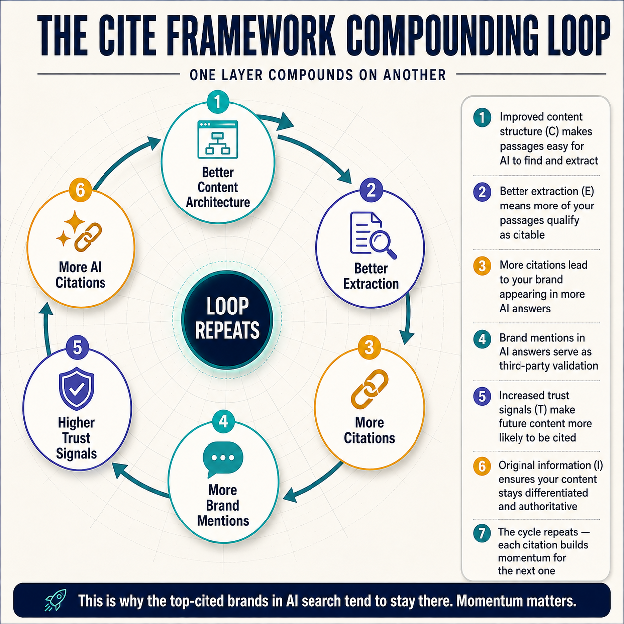
One CITE Framework layer compounds on another.
How it works:
- Improved content structure (C) makes passages easy for AI to find and extract
- Better extraction (E) means more of your passages qualify as citable
- More citations lead to your brand appearing in more AI answers
- Brand mentions in AI answers serve as third-party validation
- Increased trust signals (T) make future content more likely to be cited
- Original information (I) ensures your content stays differentiated and authoritative
- The cycle repeats - each citation builds momentum for the next one
This is why the top-cited brands in AI search tend to stay there. Momentum matters.
Conclusion
Traditional SEO is about rankings. AI search is about citations.
Ranking remains important - it’s still the baseline filter that gets your content into the candidate pool. But once you’re in the top 20, the game changes. AI systems no longer rank pages; they retrieve passages and synthesize them into answers.
The CITE Framework - Content Architecture, Information Gain, Trust Signals, and Extraction Optimization - is the system for winning in this new environment.
Brands that implement the framework systematically see measurable results: higher citation rates, more brand visibility in AI answers, increased referral traffic from AI platforms, and stronger competitive positioning.
Frequently Asked Questions
Why do lower-ranked pages sometimes get cited in AI Overviews?
Ranking position is a baseline filter, not a citation determinant. A page ranked on position 15 with a clear, unique answer can be cited instead of the position 1 result.
How does passage-level retrieval differ from page ranking?
Page ranking evaluates the entire page’s authority and relevance. Passage-level retrieval evaluates individual text blocks (40-200 words) for extractability and citation-fitness.
Does AI value brand mentions more than backlinks?
In 2026, earned authority (brand mentions, reviews, press coverage) now outweighs raw backlink count. AI systems now prioritize third-party validation via reviews, mentions, and authority signals.