 C. Sivaraj
The biggest Google ranking factor people ignore is search intent satisfaction, which measures whether your page fully resolves the reason behind a search, not whether it contains the right words.
Intent satisfaction is invisible in most tools, so it gets skipped. That gap explains why pages with fewer links and weaker on-page optimization routinely outrank technically “better” pages.
Google has never confirmed a single #1 ranking factor, but its systems consistently reward pages that end the search journey.
Why Is There No Single Google Ranking Factor?
Google has never confirmed one dominant ranking factor. Google’s documentation describes hundreds of signals working together, weighted differently per query. The search for a “#1 factor” is a myth built by decade-old correlation studies, not by anything Google has published.
Google Search Central states that its ranking systems weigh many factors and that their weighting varies by query.
How weighting shifts by query A local query leans on proximity. A medical query leans on E-E-A-T. A news query leans on freshness.
What Does Google Actually Reward?
Google rewards pages that better resolve the searcher’s task than alternatives. Its Helpful Content signals, folded into the core algorithm in March 2024, evaluate whether content was made for people or made for rankings. Everything else is a proxy for that outcome.
Helpful content
The Helpful Content System stopped being a separate update in March 2024. It now runs inside the core algorithm continuously, per Google Search Central. Sites can no longer wait out a “helpful content update.” The evaluation never stops.
User satisfaction
Google’s Search Quality Rater Guidelines run over 170 pages, and most of that document is about one question. Did the page meet the user’s need fully? Raters score pages on “Needs Met,” not keyword usage.
Intent fulfillment
Ahrefs found that 96.55% of pages get zero organic traffic from Google. Most of those pages aren’t thin or broken. They answer a question nobody asked in that form, or they answer the right question worse than ten other pages.
What Is the Ranking Factor Most People Ignore?
Search intent satisfaction is the most ignored ranking factor. It means your page matches the format, depth, and outcome the searcher expected, and leaves no reason to click back to the results. Google measures this through behavior patterns at scale, and no keyword tool shows it.
The four intent types you must match
| Intent type | What the searcher wants | Content format that satisfies it |
|---|---|---|
| Informational | An answer or explanation | Guide, definition, tutorial |
| Commercial | Help choosing | Comparison, review, “best of” list |
| Navigational | A specific page or brand | Brand page, login, official doc |
| Transactional | To act or buy | Product page, pricing, signup |
Mismatched intent kills rankings faster than any technical issue. A product page will not rank for “what is schema markup” no matter how many links it earns. Google’s systems learned this pattern from billions of search sessions.
How to spot intent mismatch
Search your target keyword and study the top 5 results. If they are all listicles and your page is a service page, you have an intent problem, not a content quality problem. Fix the format before touching anything else.
Why Don’t Keywords Alone Rank Pages?
Keywords alone don’t rank pages because Google matches meaning. Since BERT in 2019, which affected about 10% of English queries at launch, Google interprets context, and MUM (2021) extended that across languages and formats. Repeating a phrase adds nothing.
The meta keyword myth
Google publicly confirmed in 2009 that the meta keywords tag is not a ranking signal and it’s not important. Google’s Senior Search Analyst John Mueller wrote on Reddit:

Seventeen years later, “does Google use meta keywords” still gets searched thousands of times a month. That says a lot about how slowly SEO myths die.
Context beats repetition
A page about technical SEO audits can outrank pages that repeatedly use the phrase “technical SEO checklist” even if it never includes that exact keyword. Google’s semantic systems understand the topic through comprehensive coverage, not keyword repetition.
Explaining related concepts such as crawlability, indexation, Core Web Vitals, XML sitemaps, robots.txt, structured data, and internal linking demonstrates topical expertise. Comprehensive topic coverage signals relevance and authority, while keyword density alone signals nothing.
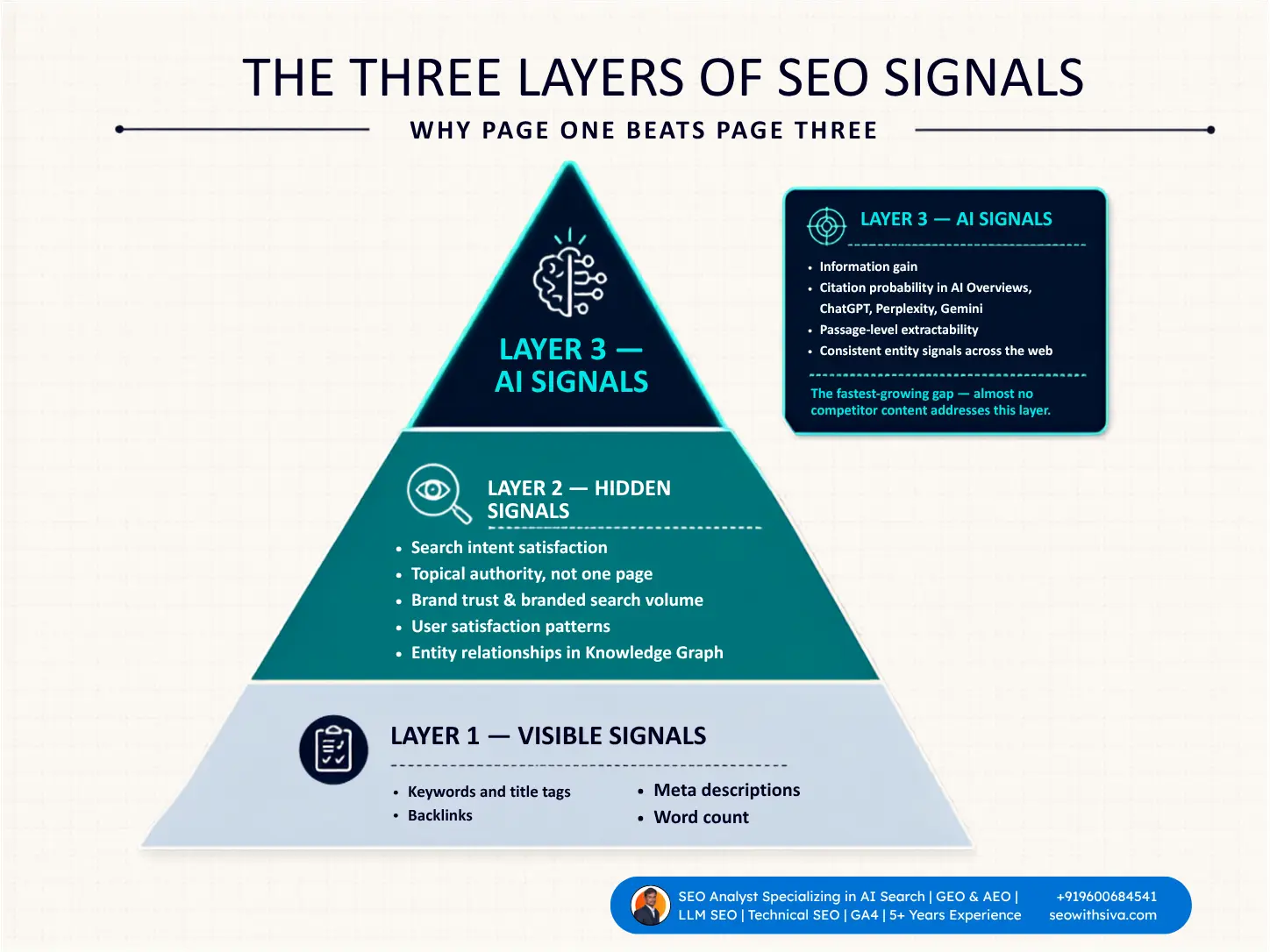
What Is the SEO Iceberg Framework?
The SEO Iceberg Framework is a model that splits ranking signals into three layers. Visible signals sit above the waterline and get all the attention. Hidden signals sit below it and decide most rankings. AI signals form the deepest layer and decide who gets cited in AI answers.
How Has AI Changed Google’s Ranking Priorities?
AI moved Google from ranking pages to synthesizing answers. AI Overviews now appear on roughly 50% of US queries per Google’s own February 2026 disclosure, so getting cited inside the answer now matters as much as ranking under it.
The numbers describe a different search channel than the one most SEO advice was written for:
- SparkToro’s June 2026 study found 68% of US Google searches end without a click.
- Seer Interactive measured organic CTR dropping from 1.76% to 0.61% (a 61% decline) when an AI Overview appears.
- The same Seer research found brands cited inside AI Overviews earn about 120% more organic clicks per impression than uncited brands on the same queries.
That last stat is the strategic one. Visibility inside AI answers compounds. Invisibility compounds too.
What this means for ranking priorities
Google’s retrieval now works at the passage level. It pulls the best-matching section, not the best-matching page. Entity understanding decides whether Google trusts your brand as a source at all. Information gain decides whether your passage gets picked over the ten near-identical ones already indexed.
Writing “another good article” on a covered topic is now a losing strategy. The retrieval layer has no reason to select content that adds nothing new.
Which 10 Signals Actually Matter in 2026?
Ten signals carry most ranking outcomes in 2026, and they split cleanly between classic SEO and AI-era requirements. The table below ranks them by leverage, meaning how much movement you get per unit of effort, based on where competitor content is weakest.
| # | Signal | What it measures | Why it’s high-leverage now |
|---|---|---|---|
| 1 | Search intent satisfaction | Whether the page ends the search | Invisible in tools, so competitors ignore it |
| 2 | Information gain | What you add beyond existing results | Patented scoring; decides AI citation |
| 3 | Topical authority | Depth across a full subject | Site-level scores confirmed in the 2024 leak |
| 4 | E-E-A-T (Experience added Dec 2022) | First-hand experience and trust | Weighs heaviest on YMYL queries |
| 5 | Entity clarity | How well Google understands who you are | Feeds Knowledge Graph and AI answers |
| 6 | Content helpfulness | People-first vs. search-first content | Runs continuously in core since March 2024 |
| 7 | Passage extractability | Self-contained, liftable sections | AI systems retrieve passages, not pages |
| 8 | Backlinks | Third-party endorsement | Still real, but a trust threshold, not a race |
| 9 | Page experience | Core Web Vitals, mobile, HTTPS | A filter, not a differentiator |
| 10 | Freshness | Recency where the query demands it | Query-dependent, decisive for news and stats |
Notice where backlinks sit. Not gone, not #1. They function like a credit check now. You need to pass it, and passing it harder wins you nothing extra on most informational queries.
How Do You Optimize for Search Intent Satisfaction?
Follow these seven steps to align a page with search intent and raise its citation potential. The process takes one working session per page and applies to new content and rewrites equally.
- Search your target keyword in an incognito window. Record the dominant format of the top 5 results (guide, list, comparison, tool, video).
- Classify the intent. Match the query against the four intent types. If the SERP mixes intents, pick the dominant one and cover the secondary one in a section.
- List every question the SERP answers. Pull People Also Ask boxes, AI Overview sub-points, and the H2s of the top 3 pages into one document.
- Find the gap. Identify at least one question, data point, or angle none of the top results covers. This becomes your information gain. If you can’t find one, add original data or first-hand experience.
- Answer the core question in your first 100 words. No wind-up. Searchers and AI systems both extract the top of the page first.
- Make every H2 section self-contained. Each section should make sense if lifted out with zero surrounding context, because that is exactly how AI retrieval uses it.
- Check the click-back test after publishing. In Google Search Console, watch impressions vs. position over 4 to 6 weeks. Rising impressions with stalling position usually signals an intent or satisfaction gap, not a link gap.
What Mistakes Keep Pages From Ranking?
Most non-ranking pages fail on intent or information gain, not on technical SEO. These are the patterns that show up again and again in audits:
- Publishing the 11th version of the same article. If your outline matches the top 10 results, Google has no retrieval reason to surface you.
- Optimizing a page when the problem is the site. Topical authority is measured across your whole coverage of a subject. One great page on an unfocused site underperforms.
- Chasing links before fixing format. Links can’t rescue a service page targeting an informational query.
- Ignoring AI Overview presence on your keywords. If an AI Overview triggers on your target query, your content plan must include getting cited in it, not just ranking under it.
- Writing without first-hand experience on YMYL topics. Since the December 2022 Quality Rater Guidelines update, Experience is scored explicitly. Generic rewrites read as exactly that.
Stop Optimizing for a Factor That Doesn’t Exist
The search for the #1 ranking factor is the wrong search. Google rewards pages that end the search journey, add information the index doesn’t have, and come from sites it recognizes as subject authorities. Backlinks and keywords still count, but they’re the visible tip of the iceberg, and everyone already has them covered.
If you want a second set of eyes on where your content sits on the iceberg, SEOwithSiva runs intent and AI-visibility audits that show exactly which of the 10 signals your pages are missing. Start with your highest-traffic page that’s stuck on page two. That’s almost always an intent problem wearing a link problem’s clothes.
Frequently Asked Questions
Does Google still use backlinks in 2026?
Yes. Backlinks remain a trust signal, but they act as a threshold rather than a race.
Does AI-generated content rank on Google?
Yes, AI-assisted content with original data, experience, and editing ranks fine. Google’s guidance targets low-quality content regardless of how it was produced.
Does E-E-A-T directly affect rankings?
E-E-A-T is not a single score, but Google’s systems approximate it through signals like author entities, citations, and site reputation. It weighs heaviest on health, finance, and other YMYL queries.
Why doesn’t my content rank despite good SEO?
The most common causes are intent mismatch (wrong format for the query) and zero information gain. Both are invisible in most SEO tools, which is why audits miss them.
Is content still king in 2026?
Helpful content is. Volume content is not. Content that adds nothing new gets neither rankings nor citations, regardless of the quality of the prose.
How do I get cited in Google AI Overviews?
Lead each section with a direct answer under 50 words, keep sections self-contained, include verifiable stats with named sources, and maintain consistent entity information about your brand across the web.
Do meta keywords matter for Google rankings?
No. Google confirmed in 2009 that it does not use the meta keywords tag for ranking. Time spent on it is wasted.
What matters more: topical authority or domain authority?
Topical authority. Domain authority is a third-party metric Google doesn’t use. The 2024 API leak confirmed site-level quality scoring tied to subject coverage, which topical authority describes far better.