
The landscape of digital information is undergoing a seismic shift. Search is no longer just a list of blue links; it’s an interactive, conversational experience powered by sophisticated artificial intelligence. With AI search platforms like ChatGPT attracting 5.9 billion monthly visits, the imperative for content creators and marketers is clear: adapt or become invisible. Optimizing for this new paradigm requires more than tweaking keywords; it demands a fundamental rethinking of how we create, structure, and present information. This article provides a comprehensive guide to navigating this new frontier, ensuring your content is not just found, but chosen and cited by AI search engines.
Introduction
The rise of generative AI has ushered in a new era of information discovery. Users now expect direct, synthesized answers, not just links to potential ones. Understanding how to position your content as a trusted source for these AI-driven responses is the next critical evolution in digital strategy.
The Evolution of Search: From Keywords to Conversations
Traditional SEO was built on the foundation of keywords. We targeted specific phrases that users would type into a search box. AI search, however, operates on a different level. It leverages Large Language Models (LLMs) to understand intent, context, and the semantic relationships between concepts. The query is no longer a static string of text but the beginning of a conversation. AI engines aim to provide comprehensive answers by pulling and synthesizing information from multiple authoritative sources, fundamentally changing the goal of content optimization.
Why AI Content Optimization Matters Now
Ignoring AI search is no longer an option. As AI Overviews and generative responses become more integrated into search engine results pages (SERPs), the traditional “click” is being replaced by the “AI citation.” Visibility is shifting from ranking on a list to being featured within a generated answer. Content that is not structured for AI comprehension risks being overlooked entirely, leading to a significant loss of traffic, authority, and brand presence in this rapidly growing ecosystem.
AI Search Ecosystem: How AI Works?
To optimize for AI, one must first understand its mechanics. AI search is not merely a faster version of traditional search; it is a different process altogether, focused on synthesis rather than simple retrieval.
Traditional vs. AI Search: A Fundamental Shift
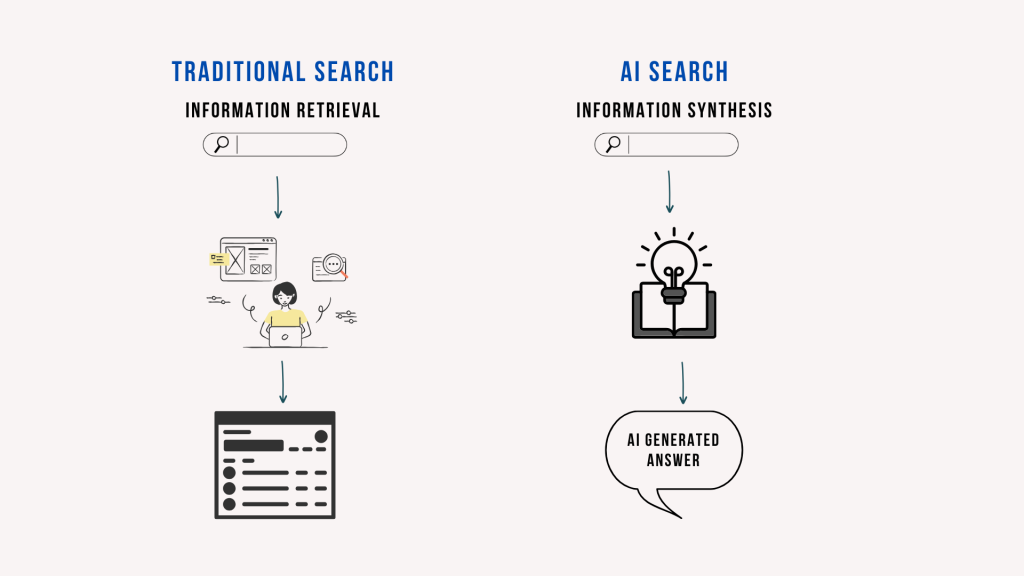
Traditional search retrieves a list of documents, while AI search synthesizes information from multiple sources to provide a direct answer.
Traditional search engines excel at information retrieval. They crawl, index, and rank web pages based on relevance signals like keywords and backlinks. The output is a ranked list of documents for the user to explore.
AI search, in contrast, is about information synthesis. It deconstructs queries to understand user intent, scans a vast corpus of indexed content to find relevant information fragments, and then constructs a new, coherent answer. In this model, ranking applies not just to whole pages, but to the individual concepts and data points within those pages.
The Mechanics of AI Content Processing
When an AI engine receives a query, it doesn’t just look for pages that contain the query’s words. It “reads” and processes content, breaking it down into manageable chunks or data points. It evaluates each piece for authority, accuracy, and relevance before weaving them together. This process, often described as “query fan-out and content synthesis,” means the AI assistant is effectively creating a new piece of content on the fly, citing its sources. Your goal is to make your content’s “chunks” the most authoritative and easiest for the AI to use.
How It Works (Step-by-Step)?
Step 1: AI Identifies the User’s Intent
AI search engines start by interpreting what the user actually wants – not just the words they typed. Informational, comparative, transactional, and exploratory intents are treated differently.
Content that clearly aligns with one primary intent performs best.
Step 2: AI Evaluates Content Quality
AI systems assess whether your content:
- Fully answers the question
- Uses accurate, up-to-date information
- Is written clearly and logically
- Avoids misleading or exaggerated claims
This is where people-first writing becomes essential.
Step 3: Trust & Authority Signals Are Applied
AI engines look for signals of credibility, including:
- Demonstrated expertise
- Consistent topical coverage
- Clear authorship or brand authority
- Supporting explanations and examples
Content that feels generic or surface-level is filtered out.
Step 4: Content Is Structured for Reuse
Well-structured content includes headings, lists, definitions, and FAQs. This structure is easier for AI to extract and reuse in summaries and answers.
Step 5: User Interaction Feeds the System
If users engage, scroll, stay longer, or trust the answer, AI systems learn that the content is valuable. Poor engagement signals reduce future visibility.
Building Unquestionable Authority and Trust (E-E-A-T for AI)
In an AI-driven world, trust is the most valuable currency. AI models are explicitly designed to prioritize information from sources that demonstrate high levels of Experience, Expertise, Authoritativeness, and Trustworthiness (E-E-A-T).
E-E-A-T as the Cornerstone for AI Visibility
For an AI, E-E-A-T is not just a quality guideline; it’s a risk mitigation strategy. To avoid generating inaccurate or harmful “hallucinations,” AI systems rely heavily on signals of credibility. Content from recognized experts, well-established organizations, and sources with a history of providing reliable information is weighted far more heavily. This means your content must be impeccably accurate, well-supported, and transparent about its authorship and sourcing.
Cultivating Brand Authority and Earning AI’s Trust
Building authority for AI involves a combination of on-page and off-page signals. On-page, this includes clear author bios, credentials, and links to supporting evidence. Off-page, it means securing mentions, links, and citations from other reputable websites in your niche. Consistently publishing high-quality, in-depth content on a specific topic reinforces your topical authority, signaling to AI that you are a reliable source for that subject matter.
Structuring Content for AI Comprehension: The “AI-Native” Approach
AI models process language differently than humans. To be effectively utilized, content must be structured in a way that is clear, logical, and easy for a machine to parse and deconstruct. This is the “AI-Native” approach.
Clarity, Conciseness, and Directness: Speaking AI’s Language
AI values efficiency. Content should get straight to the point. Use clear headings, short paragraphs, and simple sentence structures. Answer questions directly and upfront, often within the first few sentences of a section. Avoid ambiguous language, jargon without explanation, and long, rambling introductions. The goal is to make each piece of information as distinct and understandable as possible.
Modular Content and Logical Flow for AI Retrieval
Think of your content not as a single article, but as a collection of modular, self-contained “answer blocks.” Each section, guided by a specific heading or subheading, should comprehensively answer a single question or cover a single concept. This modular structure allows an AI to easily extract a specific chunk of information to use in a generated response without needing the context of the entire page. A logical flow, using headings (H2, H3) to create a clear hierarchy, helps the AI understand the relationships between these modules.
Optimizing for Zero-Click Search and AI Overviews
Many AI-generated answers aim to satisfy the user’s query directly on the SERP, leading to a “zero-click” search. To appear in these summaries, your content must be “snippable.” Create concise, factual, and well-defined answer blocks (often 40-60 words) that directly address common user questions. Using lists, tables, and bullet points also makes data easier for AI to parse and present in summary formats.
Mastering Structured Data and Semantic SEO
If clear content structure is the language AI understands, structured data is the grammar that makes it fluent. Semantic SEO and schema markup are critical for removing ambiguity and explicitly defining the context of your content for machines.
The Power of Schema Markup for AI Understanding
Schema markup is a vocabulary of code added to your website’s HTML that helps search engines understand the meaning and relationships behind your content. It explicitly labels elements like an author’s name, an organization’s address, a product’s price, or the steps in a how-to guide. For an AI, this is invaluable. It transforms your content from a string of words into a structured database of entities and properties, making it far more reliable and useful.
Essential Schema Types for AI Optimization
While hundreds of schema types exist, certain ones are particularly beneficial for AI optimization. These include:
- FAQPage: Clearly marks up question-and-answer formats, making them ideal for AI retrieval.
- HowTo: Breaks down step-by-step instructions in a machine-readable format.
- Article: Defines key elements like author, publisher, and publication date, reinforcing E-E-A-T signals.
- Organization/Person: Establishes the entities behind the content, building authority.
- Product: Provides structured data about products, including price, availability, and reviews.
Semantic SEO: Building Contextual Relevance
Semantic SEO is the practice of optimizing for topics and concepts, not just keywords. It involves creating comprehensive content that covers a subject in depth and building a network of internal links between related pages. This strategy creates a rich contextual web that helps AI models understand your site’s overall expertise on a topic, making it more likely that your content will be selected as an authoritative source.
Becoming an AI’s Preferred Source: Advanced Citation Strategies
The ultimate goal in AI search is not just to be seen, but to be cited. A citation in an AI-generated answer is the new top ranking – an explicit endorsement of your content’s authority and value.
The “Why” Behind AI Citations: Trust and Accuracy
AI engines cite sources for two primary reasons: to lend credibility to their generated answers and to provide users a path to deeper information. A citation acts as a footnote, demonstrating that the information is not fabricated but is grounded in data from a reliable source. Therefore, AI is programmed to select sources that are demonstrably trustworthy and factually accurate.
Proactive Strategies for Citation-Worthiness
To become a citable source, focus on creating unique and valuable content. This includes publishing original research, compiling proprietary data, and offering expert analysis that cannot be found elsewhere. Present key findings in clear, quotable statements. Use data visualizations like charts and graphs with descriptive text that AI can easily parse. The more your content serves as a primary source of information, the more likely it is to be cited.
Technical Foundations for AI Crawlability and Discovery
All the content optimization in the world is useless if AI crawlers cannot access and index your site effectively. A solid technical foundation is a non-negotiable prerequisite for AI visibility.
Ensuring Content is Accessible to AI Crawlers
Core technical SEO principles remain vital. Ensure your website has a clean site architecture, a logical internal linking structure, and a clear XML sitemap. Your site must be mobile-friendly and load quickly, as user experience signals are still a key component of how both traditional and AI systems evaluate quality. Blockages in your robots.txt file or improper use of noindex tags can render your content invisible to AI.
The Emerging Role of llms.txt and Firewall Controls
As web scraping by AI models becomes more prevalent, a new standard for control is emerging. While not universally adopted, the concept of a llms.txt file (similar to robots.txt) allows website owners to specify which AI models are permitted to use their content for training purposes. Understanding and implementing these controls will become increasingly important for managing how your intellectual property interacts with the AI ecosystem.
Measuring AI Search Performance Beyond Traditional Metrics
The rise of AI search necessitates a new approach to measuring performance. Traditional metrics like keyword rankings and organic clicks, while still relevant, do not tell the whole story.
Adapting to Zero-Click Search and AI-Generated Responses
With AI providing direct answers, success can no longer be measured solely by traffic to your website. The new reality is that visibility within an AI Overview, even if it doesn’t result in a click, is a significant brand win. It positions your organization as an authority. The challenge is shifting the measurement mindset from traffic acquisition to brand impression and authority display within the SERP itself.
Key Performance Indicators for AI Optimization
Marketers need to adopt new KPIs. According to DemandSage, 58% of marketers plan to use AI for content and SEO, making tracking AI-specific performance crucial. Key metrics now include:
- Citation Frequency: How often is your domain cited in AI-generated answers for key topics?
- Visibility in AI Overviews: Track the percentage of relevant queries for which your content appears in an AI summary.
- Branded Search Lift: Increased authority from AI citations can lead to a rise in users searching directly for your brand.
- Attributed Traffic: Monitor referral traffic from clicks on citations within AI responses.
Ethical Considerations and Future-Proofing Your Content
Optimizing for AI is not just a technical exercise; it carries ethical responsibilities and requires a forward-looking strategy that anticipates the next wave of innovation.
Mitigating AI Hallucinations and Misinformation
Content creators are now on the front lines of the fight against AI-generated misinformation. By providing clear, accurate, and well-sourced information, you help train AI models to deliver more reliable results. Fact-check your content rigorously and update it regularly to ensure its accuracy. This commitment to truthfulness not only serves the greater good but also strengthens your E-E-A-T signals, making your content more trustworthy to both humans and AI.
Embracing Multi-Modal and Conversational AI
The future of search is multi-modal (text, image, video, and audio) and increasingly conversational. Prepare by optimizing all forms of content. Add descriptive alt text to images, provide transcripts for videos and podcasts, and structure your content to answer follow-up questions naturally. A 2025 HubSpot report noted that 54% of content marketers are already using AI for ideation. This trend will only accelerate, making a holistic, multi-modal content strategy essential for future success.
Conclusion
The transition to an AI-first search landscape represents a pivotal moment for content creators. Success is no longer about winning a keyword game but about becoming a trusted partner in the AI’s mission to deliver accurate, comprehensive answers. The strategy is clear: shift your focus from keywords to concepts, from monolithic pages to modular content, and from simple rankings to authoritative citations.
To begin, conduct an audit of your existing content through the lens of an AI.
- Reinforce E-E-A-T: Ensure every piece of content has clear authorship, is rigorously fact-checked, and is supported by evidence.
- Restructure for Clarity: Break down long-form content into logical, question-based modules with direct, concise answers.
- Implement Structured Data: Use Schema markup to explicitly define the key entities and information on your most important pages.
- Create Citation-Worthy Assets: Invest in original research and unique insights that establish you as a primary source.
By embracing these principles, you can build a content strategy that is not only resilient but thrives in the new frontier of AI-powered search, ensuring your expertise continues to reach and resonate with audiences for years to come.
What AI Search Optimization Tools Do?
– Analyze semantic relevance (entities, topics, relationships)
– Improve content structure for AI parsing
– Optimize for answer-style visibility
– Enhance E-E-A-T and authority signals
– Help content get cited in AI-generated answers
Does AI search replace traditional SEO?
No. AI search builds on traditional SEO fundamentals like crawlability, relevance, and quality. However, ranking alone is no longer enough – content must also be trustworthy, well-structured, and suitable for AI-generated answers.
Which content performs best in AI search results?
Content that clearly answers a specific question, demonstrates real expertise, covers topics comprehensively, and is written in simple, logical language performs best in AI search environments.
Do keywords still matter for AI search optimization?
Keywords still help with relevance, but AI systems prioritize meaning and clarity over repetition. Overusing keywords can reduce readability and hurt AI selection rather than improve it.
Is AI search optimization ethical and sustainable?
Yes. AI search optimization focuses on earning trust through helpful, people-first content rather than exploiting loopholes, making it a long-term and sustainable approach to visibility.